Autism and Religion: How to Survive Mass with Sensory-Sensitive Kids
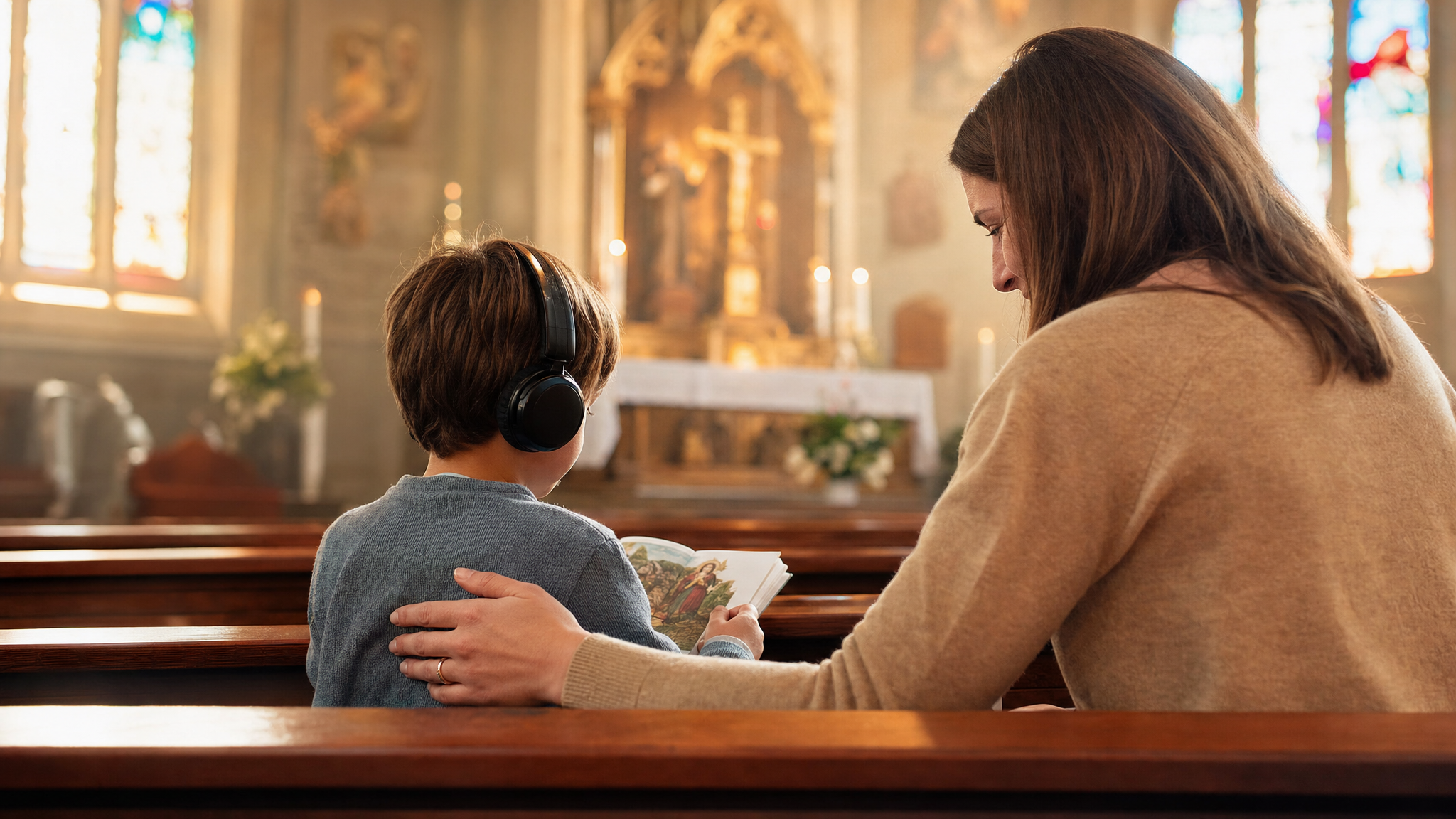
If you've ever carried a melting-down child out of Mass under one arm while mouthing "sorry" to the pew behind you — this one's for you.
For Catholic families raising kids with sensory processing differences, ADHD, autism, or OCD, the weekly call to worship can feel less like a moment of grace and more like a gauntlet. The music. The incense. The expectation to sit still for 45 minutes. It's a lot — for any kid, but especially for one whose nervous system is already working overtime.
Ginny Kochis knows this life intimately. She's a Catholic wife, mom, neurodivergent parent coach, and founder of Quirky Catholic Kids — a ministry built specifically for Catholic families navigating neurodivergence with faith. She joined Jim and Meghan on the Modern Catholic Family podcast to share what she's learned raising her own kids and coaching hundreds of moms through the same challenges. The tips she shared for getting through Mass? Practical, grace-filled, and genuinely game-changing.
Start Before You Even Walk in the Door
One of the most powerful things you can do as a parent is know your Masses. Not every Mass is the same, and for a sensory-sensitive child, the difference between a full choir with incense and a stripped-down early morning liturgy can be the difference between a peaceful hour and a full meltdown.
Ginny recommends scouting your parish's Mass schedule with your child's sensory profile in mind. Which Masses tend to use incense? Which have the most music, the loudest organ, the most people? Which are quieter, shorter, more predictable?
"My parish uses a lot of incense, which can be overwhelming for kids who are sensory sensitive. So just being aware of which Masses do what — which have more music, which tend to have incense — can make a real difference."
— Ginny Kochis
Choosing the right Mass for your child isn't giving up. It's meeting your kid where they are so they can actually encounter the Eucharist — which is the whole point.
And if your parish doesn't offer a good fit? You might not be alone in wishing it did. A growing number of Catholic parishes across the country are now offering dedicated sensory-friendly Masses — liturgies intentionally adapted with reduced lighting, no incense, quieter or no music, and a welcoming posture toward movement and vocalization. Fr. Matthew Schneider, LC, a priest with autism himself, maintains a Sensory-Friendly Mass Directory tracking these parishes — as of early 2026, there are more than 26 verified locations offering them at least monthly, with the number growing. You can also search masstimes.org to explore Mass options in your area and find the right fit for your family's needs.
Pack the Right Tools (Yes, There's a List)
Preparation is everything. Ginny has a short, specific toolkit she recommends for sensory-sensitive kids at Mass — and these aren't gimmicks. Each one serves a real neurological purpose.
Noise-canceling headphones. This is Ginny's top recommendation, full stop. If the sound environment is unpredictable or overwhelming, headphones give your child's nervous system a way to regulate without having to flee. Your child is still present — they're just protected from the sensory overload that would otherwise derail the whole experience.
A wobble cushion. This was new to Jim too — and it's brilliant. A wobble cushion is an inflatable disc (usually with textured nubs) that a child sits on in the pew. It allows gentle rocking movement and provides proprioceptive input — the kind of physical sensation that helps a neurodivergent nervous system calm down and stay calm. "They still get the movement they need to help center themselves," Ginny explained, "but it's not everywhere." A few well-reviewed options on Amazon: the Gaiam Balance Disc (~$18) and the Fitwhiz Air Stability Wobble Cushion (~$15) both come with pumps and work quietly in a pew. They double as a great sensory tool at home too.
Quiet Mass aids. For younger kids, Ginny loves the Building Blocks of Faith Catechism Lego series — a picture book format kids can quietly flip through. For older kids, a simple notebook for drawing and doodling can work wonders. Ginny's son, heading into sixth grade, still brings a notebook to Mass.
"I know he's listening. But it gives him something to do so that if his mind starts spiraling — which is common with OCD — he has something to distract him from that. And he doesn't lose it."
— Ginny Kochis
These tools aren't distractions from worship. They're the scaffolding that makes worship possible for a brain that works differently.
Sit Up Front (We Know, We Know)
This one sounds counterintuitive — and yes, Ginny acknowledged the running joke that sitting in the front row is practically anti-Catholic. But hear her out.
For sensory-sensitive kids, the back of the church is actually harder. There's more ambient noise, more movement in the periphery, more visual distraction. The front of the church gives a child a clear focal point — the altar — and fewer distractions on either side.
"I find it's been easier for the kids to stay focused," Ginny said. And yes, if your child needs to make a quick exit, you can still do it. You've done it before. You'll do it again. God sees the whole thing and He is not bothered.
The front pew is also a quiet, unspoken signal to your child: this matters to us, and we're going to be present together. That kind of embodied witness, repeated week after week, does something to a child's interior life that no curriculum can replicate.
Give Yourself Grace — and Keep Showing Up
Here's the thing Ginny wants every Catholic parent of a neurodivergent child to know: your child's presence at Mass — messy, imperfect, headphones-on presence — matters.
The Eucharist doesn't require your child to sit perfectly still and follow along in a missal. It requires showing up. God meets us where we are, and He meets our kids there too.
"Typical and holy aren't the same thing."
— Ginny Kochis
The saints didn't all look the same. The Martin family — St. Thérèse's parents, Louis and Zélie — may well have had neurodivergent children in their home. Holiness doesn't have a neurological prerequisite.
If some Sundays end in the parking lot, counting it as a win that you made it to the entrance — that counts. If the wobble cushion falls off the pew and the headphones slip and you're sweating through the Gloria — that counts too. You are raising a child who knows that Mass is where your family goes. That seed is being planted, whether it looks like it or not.
Keep showing up. The grace does the rest.
Listen to the Full Episode
This segment is just one piece of a much richer conversation. In the full episode, Ginny and Jim and Meghan talk about what neurodivergence actually is (and how to tell a tantrum from a meltdown), navigating Catholic schools with a neurodivergent child, the Catholic resources Ginny has built for these families, and the saints who might have understood this journey better than we think.
Raising Neurodivergent Kids with Faith and Joy — Episode 61 of the Modern Catholic Family Podcast.
🎧 Listen on Apple Podcasts | Listen on Spotify | Full Episode on Buzzsprout | Watch on YouTube
Frequently Asked Questions
Can a child with autism receive the Eucharist?
Absolutely — and the answer is a resounding yes, with appropriate pastoral care. A child with autism is not excluded from the Eucharist. The criterion for reception of Holy Communion is the same for persons with intellectual and developmental disabilities as for all persons: that the person be able to distinguish the Body of Christ from ordinary food. Critically, this recognition does not need to be verbal. A child who grows quiet, bows their head, reaches reverently, or shows any sign of recognizing something sacred is meeting this standard. The bar is recognition, not perfection.
Canon Law affirms that the faithful have a right to receive the sacraments and pastors have a consequent obligation to provide them unless there is a grave impediment. The USCCB's Guidelines for the Celebration of the Sacraments with Persons with Disabilities is explicit: "the existence of a disability is not considered in and of itself as disqualifying a person from receiving Holy Communion," and "cases of doubt should be resolved in favor of the right of the Catholic to receive the sacrament." Mental or developmental disability should only impede the Eucharist in the most extreme of cases — and the tradition of the Church, going back to St. Thomas Aquinas (Summa Theologiae III.80.9), is firmly on the side of inclusion.
For families navigating this, most dioceses have Special Religious Education (SPRED) programs specifically for individuals with special needs — an excellent starting point for sacramental preparation. Ginny also recommends Ignatius Press's adaptive religious education curriculum. The wisest first step is a direct conversation with your parish priest and, if needed, your diocesan office for persons with disabilities. They are equipped and obligated to help. Every baptized Catholic has a right to the sacraments — and Jesus said, "Let the children come to me" — and He meant all of them.
What is a sensory-friendly Mass?
A sensory-friendly Mass is a liturgy intentionally adapted to be more accessible for attendees with sensory processing differences or autism. This might include reduced lighting, no incense, quieter music or no music, a designated quiet space or sensory room, and a welcoming attitude toward movement or vocalization. The movement is growing: Fr. Matthew Schneider, LC maintains a national directory of parishes offering these Masses. You can also search masstimes.org to find options near you, or ask your diocese's Office for Persons with Disabilities.
Are noise-canceling headphones allowed in church?
Absolutely. There is no liturgical rule against noise-canceling headphones, and many pastors actively encourage whatever tools help a family participate in Mass. Your child's ability to be present is far more important than how that presence looks from the outside.
What is a wobble cushion and where can I get one?
A wobble cushion (also called a sensory disc or balance disc) is an inflatable rubber disc — often with nubs on the surface — that a child sits on to get gentle movement and proprioceptive input. They're widely available on Amazon for $15–$25 and are commonly used in sensory therapy settings. Look for a quiet, non-squeaky version for use in church.
What resources does Ginny Kochis recommend for Catholic families with neurodivergent kids?
Ginny has built an entire ecosystem: her book Quirky Catholic Kids: Navigating Neurodivergence with Faith and Joy (Sophia Institute Press), the Leone Circle monthly membership community, age-by-age book guides, and one-on-one coaching for moms. Find her at quirkycatholickids.com and on Instagram at @quirkycatholickids.
Jim and Meghan Schubert host the Modern Catholic Family podcast — a show for Catholic families anchoring their lives in faith.